
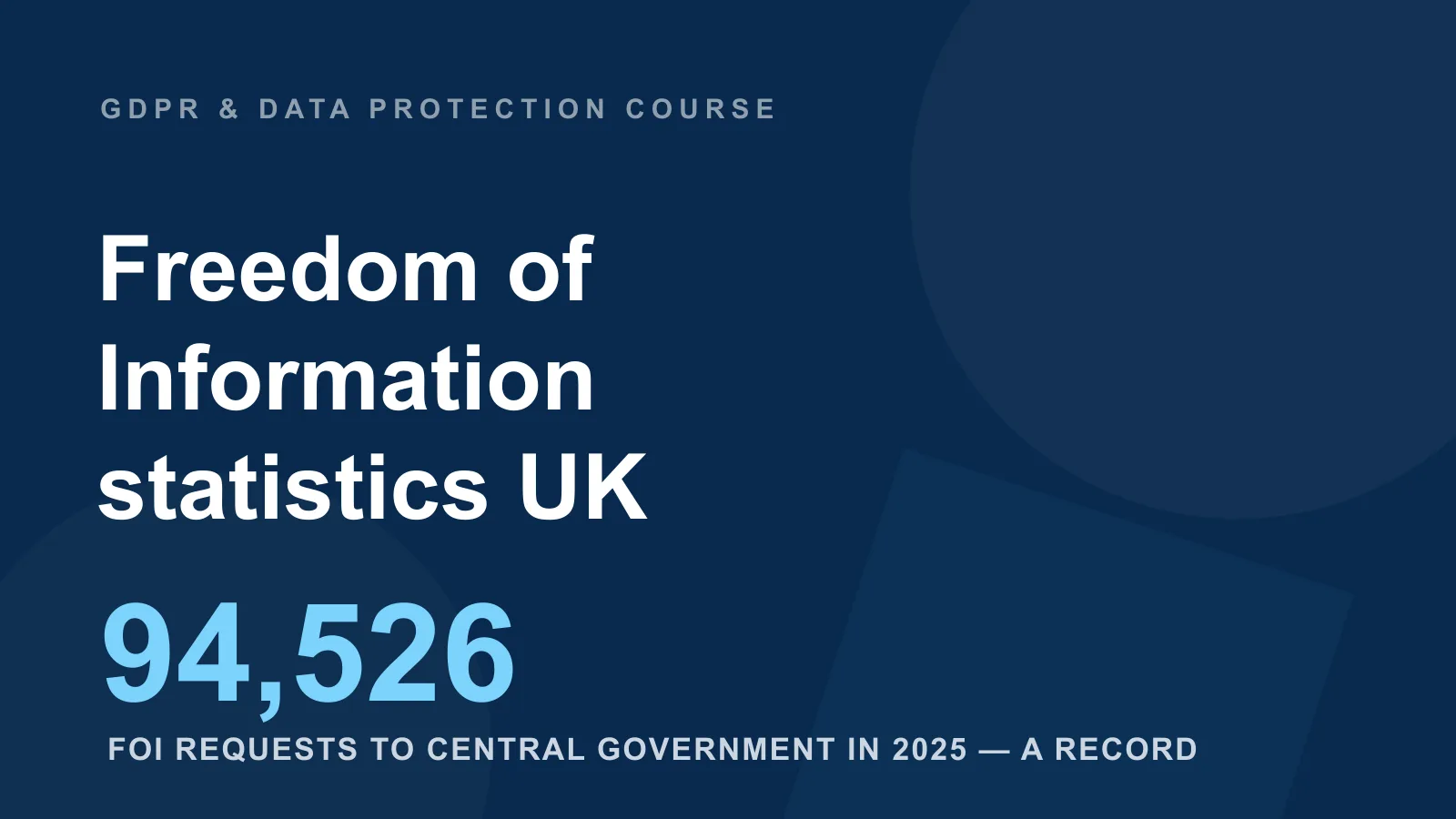
The key freedom of information statistics in one place — how many FOI requests the UK receives, how fast public bodies answer them, how often requests are refused, and how the Information Commissioner's Office polices the Act on appeal, with the data period stated next to every figure.
Two official sources sit behind almost every FOI number worth quoting. The Cabinet Office publishes quarterly and annual bulletins on how central government handles requests under the Freedom of Information Act 2000, and the Information Commissioner's Office (ICO) reports each July on the complaints and decision notices that follow when a requester challenges a refusal. Both bury their headline figures inside downloadable ODS and CSV tables — this page pulls them together into plain-English answers.
One point matters before any figure: there are two different universes here, and mixing them produces nonsense. The Cabinet Office bulletin covers only around 40 central-government "monitored bodies" — departments and major agencies — not the full sweep of authorities bound by the Act. The ICO figures are UK-wide. Every stat below is labelled with the universe it belongs to, and every source is linked in full at the end.
Key facts and figures
- 94,526 FOI requests were received by central-government monitored bodies in 2025 — the highest annual total since monitoring began in 2005, up 14% on 2024.
- 100,000+ public authorities are covered by the Freedom of Information Act UK-wide, from departments to schools, hospitals and police forces — so the true national total is far higher.
- 87% of requests to central government were answered within the 20-working-day deadline in 2025, up from 76% in 2024.
- 36% of resolvable requests were granted in full in 2025 (up from 29% in 2024).
- 35% of resolvable requests were withheld in full and a further 21% withheld in part in 2025.
- 4,720 internal reviews were requested in 2025, and the original decision was overturned in 1,054 of them (28%).
- 7,639 FOI complaints reached the ICO in 2024/25 — the second-highest total since the Act took effect.
- 2,192 statutory FOI decision notices were issued by the ICO in 2024/25 — more than 50% above earlier years' norm.
These are the latest figures available as of July 2026 — the FOI series has the strongest refresh cadence of any transparency dataset: the Cabinet Office publishes four quarterly bulletins plus one annual bulletin each year (the annual 2025 edition landed on 30 April 2026 and the January–March 2026 quarterly on 17 June 2026), and the ICO adds an annual report each July, so the headline volume, timeliness and outcome numbers here are updated at least six times a year.
How many FOI requests are made in the UK each year?
Central-government monitored bodies received 94,526 FOI requests in 2025 — the highest annual total since monitoring began in 2005, up 14% (an extra 11,485 requests) on 2024, according to the Cabinet Office's Freedom of Information statistics: annual 2025 bulletin, published on 30 April 2026. The Home Office saw the largest single rise (+2,382 requests), followed by the Department for Work and Pensions (+1,118).
That 94,526 is not the national total, though — and the gap is enormous. The Cabinet Office bulletin tracks only around 40 central-government departments and agencies. The Act itself binds more than 100,000 public authorities, from government departments to every state school, NHS body, local council and police force in the country, so the true UK-wide volume of requests runs into the hundreds of thousands each year (ICO guidance on public authorities under FOIA; House of Commons Library FOI briefing). No single body counts every request across all 100,000+ authorities, which is exactly why the central-government series is the one everyone cites — it is the only consistent, long-running measure.
The most recent quarter shows the first sign of a dip. In the first quarter of 2026 (January to March), monitored bodies received 20,592 requests — down 10% (2,343 fewer) on the same quarter of 2025 (Cabinet Office January to March 2026 bulletin, published 17 June 2026). One soft quarter does not undo a record year, but it is worth watching against the long upward trend.
What percentage of FOI requests are refused?
In 2025, 35% of resolvable requests to central government were withheld in full and a further 21% were withheld in part — up from 30% and 15% respectively in 2024 (Cabinet Office annual 2025 bulletin). "Resolvable" requests are those where the body held the information and could give a substantive answer; there were 62,515 of them in 2025. Set against that, 36% were granted in full, an improvement on the 29% granted in full in 2024.
So the picture is mixed: more requests were granted in full than the year before, but the share withheld in full or in part also rose — the middle ground of partial answers shrank. The table below lays out the 2025 outcome split against 2024.
| Outcome (resolvable requests) | 2024 | 2025 |
|---|---|---|
| Granted in full | 29% | 36% |
| Withheld in full | 30% | 35% |
| Withheld in part | 15% | 21% |
Why are requests withheld? Of the requests withheld in 2025, 26.6% hit the cost limit (the request would have cost too much staff time to answer), 2.7% were judged vexatious or repeated, and 70.7% fell under one of the Act's substantive exemptions — with Section 40, which protects the personal data of third parties, the single most commonly cited exemption (Cabinet Office annual 2025 bulletin). Section 40 is a direct data-protection provision: it exists so that answering a transparency request does not breach someone else's rights under the UK GDPR and the Data Protection Act 2018.
How long do public bodies have to respond, and how often do they meet it?
Public authorities must respond to an FOI request within 20 working days, and in 2025 central government met that deadline on 87% of requests — up sharply from 76% in 2024 (Cabinet Office annual 2025 bulletin). The 20-working-day clock is set by the Act itself; a limited extension is allowed where the authority needs more time to weigh the public-interest test on a qualified exemption, but the baseline is 20 working days for the substantive response.
Timeliness improved again in early 2026. In the first quarter of 2026, 89% of requests were answered in time, up from 76% in the same quarter of 2025 (Cabinet Office January to March 2026 bulletin). The combination of a small dip in volume and a jump in the on-time rate suggests departments got on top of their FOI queues over the year — a marked contrast with the growing backlog on the data-protection complaints side of the ICO's work, which our ICO complaints statistics page tracks in detail.
Can you appeal an FOI refusal, and how often does it succeed?
Yes — an FOI refusal can be challenged, and in 2025 central government carried out 4,720 internal reviews, overturning its original decision in 1,054 of them (28%) (Cabinet Office annual 2025 bulletin). The 4,720 reviews amount to roughly 14% of the requests that were withheld, so most refusals are accepted without challenge — but of those that are challenged internally, more than a quarter result in the body changing its mind.
The appeal ladder has two rungs. First, you ask the authority for an internal review. If you are still dissatisfied, you can complain to the ICO, which can issue a legally binding decision notice ordering the authority to disclose the information (or confirming that it was right to withhold it). The ICO received 7,639 FOI complaints in 2024/25 — the second-highest annual total since the Act took effect in 2005 — and closed 7,637 cases (ICO Annual Report 2024/25).
The ICO also cleared cases quickly relative to its data-protection workload: it closed 95% of FOI complaint cases within six months in 2024/25, against a 90% target (ICO Annual Report 2024/25). That is a notably better performance than the regulator's data-protection complaints handling over the same period.
How many FOI decision notices does the ICO issue?
The ICO issued 2,192 statutory FOI decision notices in 2024/25 (2,227 the year before) — more than 50% above the norm of earlier years (ICO Annual Report 2024/25). A decision notice is the formal, appealable ruling the ICO issues when it cannot resolve an FOI complaint informally: it states whether the authority complied with the Act and, where it did not, what it must now do.
The recent run of 2,000-plus notices a year reflects both rising complaint volumes and a deliberate push to clear cases with binding rulings rather than informal resolution. For requesters, the practical takeaway is that the ICO is a real and active backstop — a refusal is not the end of the road, and a meaningful share of challenged decisions are overturned at internal review before they ever reach the regulator.
A scoping note on what these figures are not. This page covers only complaints and decision notices under the Freedom of Information Act and the Environmental Information Regulations. The ICO's much larger data-protection complaint caseload — subject access requests, breach handling and the like — is a separate series covered on our ICO complaints statistics page, and monetary penalties under the UK GDPR sit on our GDPR fines statistics page. The two universes should never be added together.
Who uses FOI, and why does it matter for data protection?
Journalists are the heaviest users of the FOI regime, alongside campaigners, researchers, businesses and members of the public — the Act gives anyone, anywhere, the right to ask a UK public authority for recorded information, with no need to explain why. That open-access design is what makes FOI such a powerful transparency tool, and also why the Section 40 personal-data exemption does so much work: authorities constantly have to decide where one person's right to information ends and another person's right to data protection begins.
For anyone handling public-sector information, the two regimes are two sides of the same coin. An FOI officer answering a request has to apply the same data-protection principles a data protection officer applies every day — is this personal data, whose is it, and would disclosure be lawful and fair? Getting that judgement wrong in either direction leads to a complaint: withhold too much and the requester appeals to the ICO; disclose too much and you have caused a personal data breach. Training staff to recognise where FOI meets the UK GDPR is the practical link between the two, and it is exactly the ground our guide to what counts as personal data and our guide to individual rights under GDPR cover.
Frequently asked questions
How many FOI requests are made in the UK each year?
Central-government monitored bodies received 94,526 requests in 2025 — a record — up 14% on 2024 (Cabinet Office annual 2025 bulletin). That covers only around 40 departments and agencies; UK-wide, with more than 100,000 public authorities bound by the Act, the true national total is far higher, but no single body counts every request across all of them.
What percentage of FOI requests are refused?
Of resolvable requests to central government in 2025, 35% were withheld in full and a further 21% were withheld in part, while 36% were granted in full (Cabinet Office annual 2025 bulletin). The most common reason for withholding was a substantive exemption, with Section 40 (third-party personal data) cited most often.
How long do public bodies have to respond to an FOI request?
Twenty working days. In 2025 central government met that deadline on 87% of requests, up from 76% in 2024, and on 89% in the first quarter of 2026 (Cabinet Office bulletins). A limited extension is allowed only where the authority needs more time to weigh the public-interest test on a qualified exemption.
Can you appeal an FOI refusal, and how often does the ICO side with the requester?
Yes. You first ask the authority for an internal review — in 2025 that overturned the original decision in 28% of the 4,720 reviews carried out — and if still dissatisfied you can complain to the ICO, which issued 2,192 binding FOI decision notices in 2024/25 (Cabinet Office and ICO figures).
Is FOI the same as a subject access request?
No. FOI gives anyone the right to recorded information held by a public authority. A subject access request is a separate right under the UK GDPR to a copy of your own personal data, from any organisation — public or private. The volumes, deadlines and failure rates for that right sit on our subject access request statistics page.
Related guides
- ICO complaints statistics UK: volumes, outcomes & response times
- Subject access request statistics UK: volumes, deadlines and complaints
- GDPR fines UK: ICO fine & enforcement statistics
- Individual rights under GDPR: a complete guide to data subject rights
- What is personal data under GDPR?
Sources & references
- Cabinet Office — Freedom of Information statistics: annual 2025 bulletin (published 30 April 2026)
- Cabinet Office — Freedom of Information statistics: January to March 2026 bulletin (published 17 June 2026)
- Cabinet Office — Freedom of Information statistics collection (all quarterly and annual bulletins)
- Information Commissioner's Office — Annual Report and Financial Statements 2024/25 (FOI complaints & decision notices, published July 2025)
- Information Commissioner's Office — Public authorities under the Freedom of Information Act (scope and context)
- House of Commons Library — Freedom of information requests briefing (context and history)
- Campaign for Freedom of Information — analysis of the 2025 annual FOI statistics (May 2026)
FOI and data protection meet every time a public body answers a request — train your team to handle personal data lawfully under UK GDPR and the Data Protection Act 2018.
Explore the GDPR & Data Protection Course →
Mark writes about data protection, workplace compliance and accredited online training for GDPR & Data Protection Course, part of Online CPD Academy.