

A clear guide to personal data under UK GDPR — what counts, what doesn't, the special category data list, and the difference between pseudonymised and anonymised data.
Personal data is the foundation concept of GDPR. The regulation only applies once personal data is involved, so getting the definition right is the first decision in any compliance question. The definition is broad, but it has edges that matter: information about deceased people falls outside it, truly anonymised data is outside it, and some categories — special category data and criminal offence data — get extra protection.
This guide covers the definition, worked examples, the special category list, the often-confused distinction between pseudonymised and anonymised data, and what changes when special category data is involved.
The GDPR definition
Article 4(1) of the UK GDPR defines personal data as "any information relating to an identified or identifiable natural person". The same article defines an identifiable natural person as someone who can be identified directly or indirectly, particularly by reference to identifiers such as a name, identification number, location data, online identifier, or factors specific to the physical, physiological, genetic, mental, economic, cultural, or social identity of that person.
Three elements of the definition matter:
"Any information" is deliberately broad. The information can be objective (date of birth) or subjective (a customer service note saying someone seemed agitated). It can be in any format: text, numbers, images, audio, video.
"Relating to" means the information is about the person, or used in a way that affects them. A receptionist's diary entry naming who visited and when relates to the visitors. A traffic camera image relates to the people captured in it.
"Identifiable" is the load-bearing word. It captures both direct identification (name, photograph) and indirect identification — where the information becomes identifying when combined with other data the controller has or could reasonably obtain.
The "reasonably obtain" test matters. If an identifier in your hands could be linked to a person by combining it with data the controller already holds, or could plausibly access, the identifier is personal data even though it looks anonymous on its own.
Examples of personal data
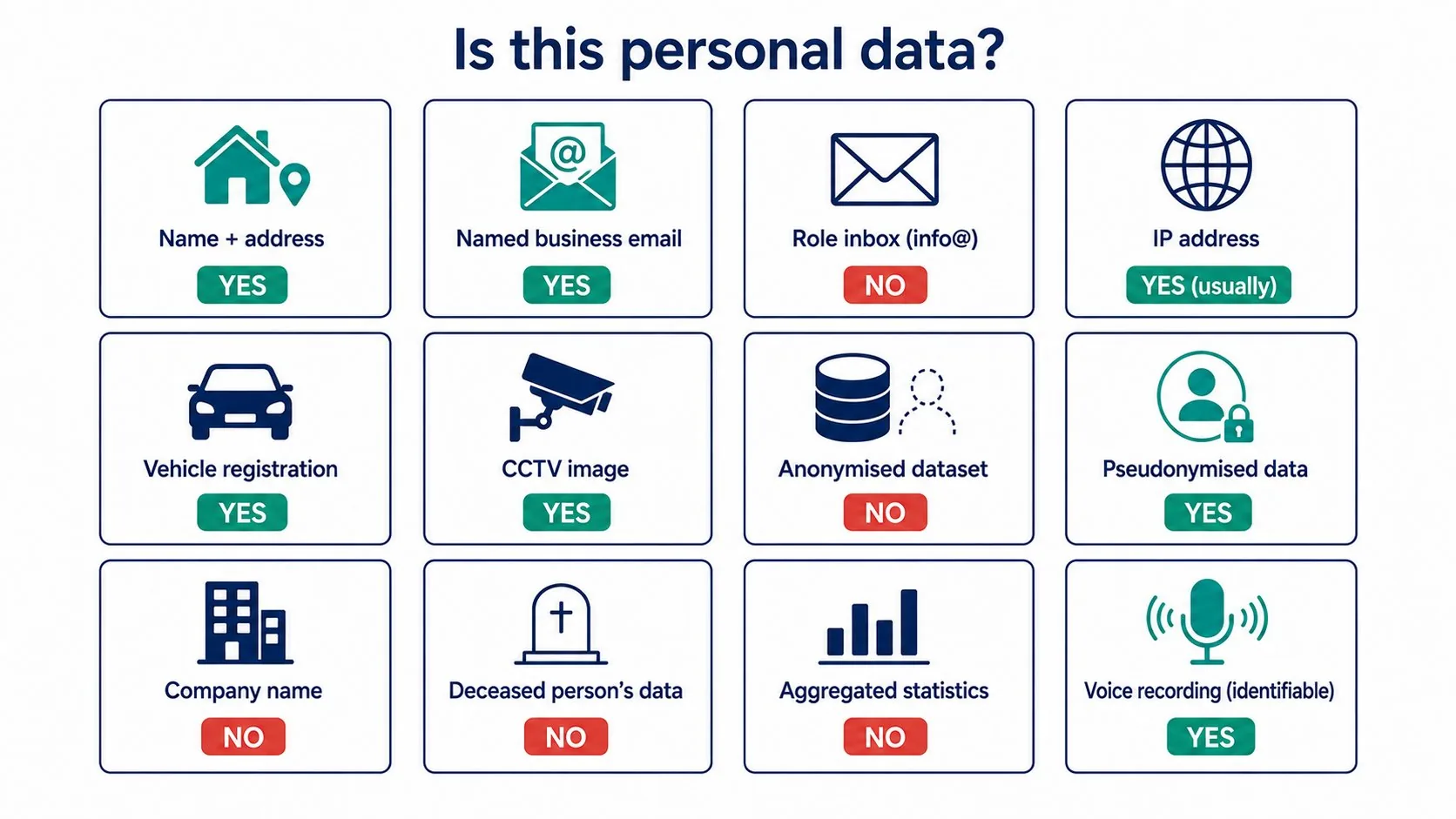
A non-exhaustive list of common categories, with notes on edge cases:
Clearly personal data
Names, addresses, email addresses, phone numbers, dates of birth, national insurance numbers, payroll numbers, employee ID numbers, photographs of individuals, voice recordings of identifiable people, CCTV footage, signatures.
Online identifiers
IP addresses, cookie identifiers, device IDs, advertising IDs (IDFA, GAID), session tokens, MAC addresses, and similar. These count as personal data when they can be linked back to a person — which, in practice, almost all of them can when combined with other data the controller holds.
Location data
GPS coordinates, mobile cell tower data, address fields, and check-in records when associated with an identifiable person.
Financial and commercial information
Bank account numbers, credit card numbers, transaction histories, loyalty programme records, purchase histories, customer reference numbers.
Employment data
Salaries, performance reviews, sickness records, training history, disciplinary records, employee notes.
Vehicle registration plates
Yes, in most contexts. The DVLA holds the registered keeper's details, and combining a plate with that database makes the plate personal data. Operators of automatic number plate recognition (ANPR) systems must treat plates as personal data.
Customer reference numbers and pseudonymised identifiers
Personal data when the controller (or a sub-processor) can link them back to a person.
Business contact details
This is the most-asked edge case. A generic email address ([email protected]) is not usually personal data because it doesn't identify a specific individual. A named business email address ([email protected]) is personal data — it identifies Sam Smith. The same applies to LinkedIn profiles, business mobile numbers, and named contact entries in CRM systems.
Photographs
Photos of identifiable people are personal data. Photos of crowds where no individual is identifiable usually aren't — but a sharp image of a small group typically is.
What is NOT personal data
A few important exclusions.
Information about deceased people
Data protection law does not apply after someone has died. (Note: some confidentiality duties, professional rules, and bereavement-related obligations may still apply through other legal regimes, but UK GDPR is not in scope.)
Information about companies and other legal persons
A company name, registered office, or VAT number is not personal data — companies are not "natural persons". The named director or contact person inside the company is a natural person, so information about them is personal data.
Truly anonymised data
Data from which a person cannot be identified, even with effort and even when combined with other information the controller has or could reasonably obtain. Genuine anonymisation is harder than it sounds and is covered in detail below.
Information that doesn't relate to a person
Aggregated statistics, depersonalised analytics, generic logs that don't trace to an individual.
The dividing line is the same in each case: the information is outside UK GDPR if it cannot be linked to an identifiable living person, today or with reasonable effort.
Special category data
Article 9 of the UK GDPR sets out a category of personal data that requires extra protection because of its sensitivity. Processing special category data is prohibited unless one of ten specific conditions in Article 9(2) applies — typically explicit consent, employment-law processing, vital interests, public-interest research, or one of the specific UK conditions set out in Schedule 1 of the Data Protection Act 2018.
The eight categories of special category data are:
- Racial or ethnic origin.
- Political opinions.
- Religious or philosophical beliefs.
- Trade union membership.
- Genetic data — information about an individual's inherited or acquired genetic characteristics.
- Biometric data used for the purpose of uniquely identifying a natural person — for example, fingerprint or facial recognition systems.
- Data concerning health — physical or mental health, including health service use.
- Data concerning a person's sex life or sexual orientation.
A subtle but important point: biometric data is only special category data when it is used for identification. A photo of someone's face is personal data, but it is not special category data — it becomes special category when a facial recognition system processes it to identify the person. The same logic applies to fingerprints: an HR record that someone has fingerprints on file is just personal data; running fingerprints through an identification system is special category processing.
The Data (Use and Access) Act 2025 gives the UK government new powers to add to the special category list in future. The current categories are unchanged, but the framework now permits expansion — potentially including children's personal data or payment information.
Criminal offence data
Article 10 of the UK GDPR covers personal data relating to criminal convictions and offences, or related security measures. This category is not "special category data" in the strict sense, but it is subject to similar restrictions. Processing is permitted only under the control of official authority or where authorised by UK law that provides appropriate safeguards.
For UK organisations, the routes for processing criminal offence data are set out in Schedule 1 of the Data Protection Act 2018. They include processing necessary for employment law purposes, for safeguarding, for legal claims, and a number of more specific situations.
A common pitfall: a job application form asking whether the applicant has unspent convictions involves criminal offence data and needs a Schedule 1 condition.
Pseudonymised vs anonymised data
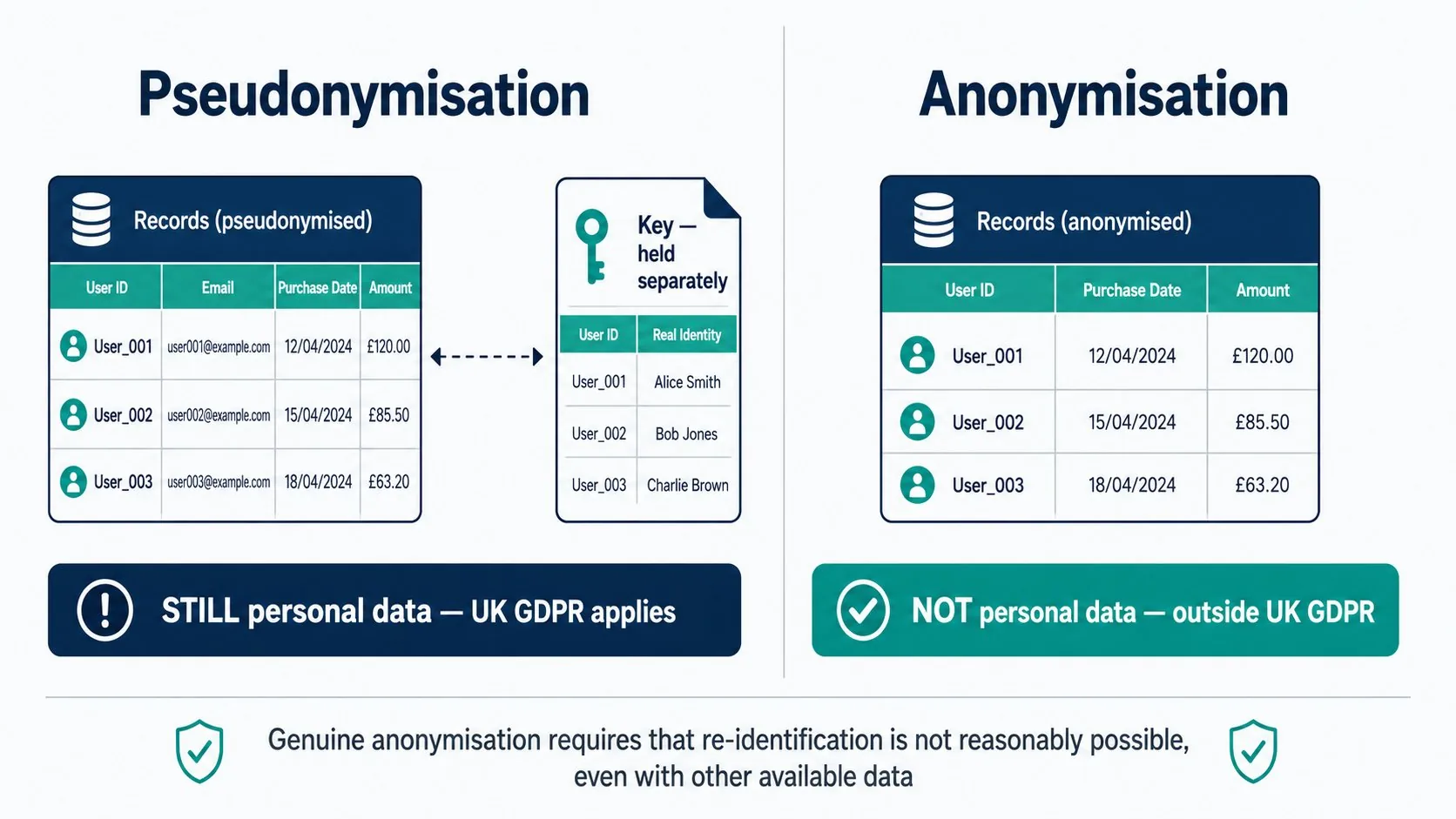
The two terms get used interchangeably, but they are technically and legally different — and the difference determines whether UK GDPR applies.
Pseudonymised data is personal data where identifying fields have been replaced with codes or tokens. The original identifiers are kept separately, typically with access controls. A customer number that maps back to a name in a separate file is pseudonymised — the link still exists, just not in the working dataset.
Pseudonymised data is still personal data. UK GDPR applies to it. Pseudonymisation is a security technique — it reduces the risk of identifying individuals in the working dataset — but it does not remove the data from the scope of the regulation.
Anonymised data is data from which a person cannot be identified, even with reasonable effort and even when combined with other available information. There is no link back to the individual. Anonymised data is outside UK GDPR.
The standard for genuine anonymisation is high. Simply removing names is not anonymisation. Removing names and other direct identifiers is often not anonymisation either — the remaining attributes can re-identify people in many real-world datasets. The ICO and the EU's data protection authorities have published guidance on what counts; the practical takeaway is that anonymisation requires assessment, not just a few field deletions.
If you anonymise data, document the process. You will need to demonstrate that re-identification is not reasonably possible, and the burden of proof sits with you.
How this changes your compliance duties
Once you know what personal data you process — and what subset is special category or criminal offence data — your obligations under UK GDPR follow:
- You need a lawful basis under Article 6 for every processing activity. For special category data, you also need an Article 9 condition. For criminal offence data, you need a Schedule 1 of the DPA 2018 condition.
- You need a privacy notice under Articles 13 and 14 covering what data you process and why.
- You need to enable individuals to exercise their rights, which depend on what categories of data you hold.
- You need to apply the principles — particularly data minimisation (collect only what you need) and storage limitation (keep it only as long as necessary).
- You need to apply appropriate security under Article 32, with extra care for special category and criminal offence data.
For more on each of these, see our seven principles guide, lawful basis guide, and individual rights guide.
Frequently asked questions
Is an IP address personal data?
Usually, yes. An IP address is an online identifier under Article 4. Combined with logs or other data, it can identify an individual user or household. The CJEU's Breyer judgment (still persuasive in UK courts) confirmed this for dynamic IP addresses.
Is a business email address personal data?
A generic role-based address (info@, sales@) is generally not personal data — it doesn't identify a specific person. A named address ([email protected]) is personal data because it identifies the individual.
Is anonymised data personal data?
No, if the anonymisation is genuine — meaning re-identification is not reasonably possible, even with other available data. Pseudonymised data, where a link to the individual still exists somewhere, is still personal data.
What is special category data?
A defined set of more sensitive personal data: racial or ethnic origin, political opinions, religious or philosophical beliefs, trade union membership, genetic data, biometric data for identification, health data, and sex life or sexual orientation.
Is health data always personal data?
Yes, when it relates to an identifiable person. Aggregated health statistics that don't trace back to an individual are not personal data, but most health records, GP notes, and occupational health files are both personal data and special category data.
Are photos personal data?
Photos that show recognisable individuals are personal data. Crowd shots where no individual is identifiable usually aren't, though the boundary depends on resolution and context.
Related guides
- GDPR cookie consent in the UK: rules after the DUAA 2025
- GDPR fines and penalties in the UK: how big, who pays, what counts
- GDPR data breach: what to do in the first 72 hours
Make sure everyone who handles personal data understands what GDPR covers and how to stay compliant.
Explore the GDPR & Data Protection Course →
Mark writes about data protection, GDPR compliance and accredited online training for GDPR & Data Protection Course, part of Online CPD Academy.